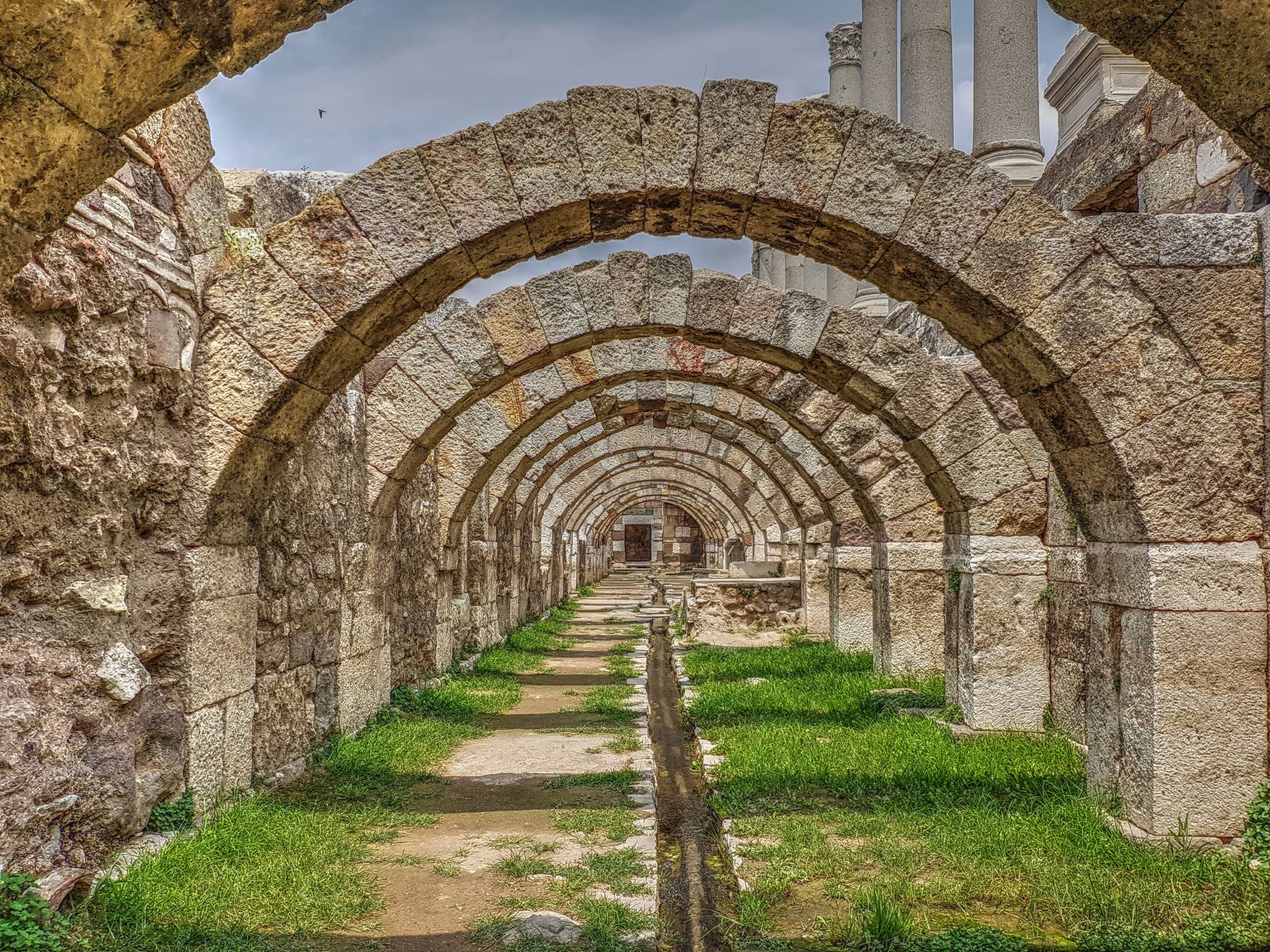
August 2026 brought a remarkable range of archaeological discoveries and announcements from across Türkiye. Among the highlights were an approximately 11,000-year-old human-and-leopard sculpture from Karahantepe, Epipalaeolithic turtle figurines from Gedikkaya Hill and In Cave, a monumental marble statue from Sardis, new Roman-period discoveries at Aspendos, including a necropolis and a statue of Asklepios, and a large early 5th-century church with mosaics and frescoes at Antandros. Excavations also revealed a monumental Hittite structure at Sapinuwa, a Roman and Early Byzantine settlement at Salkaya, and evidence interpreted as the earliest known plague in Anatolia at İznik. Particularly noteworthy was a discovery in ancient Smyrna (modern İzmir), where excavations uncovered three Late Antique rooms with previously undocumented wall paintings, adding new evidence for the city's later Roman and early Byzantine history. Together, these discoveries illustrate the extraordinary chronological and cultural diversity of Türkiye's archaeological heritage, spanning more than 10,000 years from the Epipalaeolithic to the Byzantine period.
Turkish Archaeological News collects the most important, interesting and inspiring news from Turkish excavation sites. Here's the review for August 2026. Have we missed anything? Please let us know by using Contact tab!
August 01, 2026
Int’l archaeologists uncovering Kültepe
Archaeologists from Türkiye alongside researchers from South Korea, Italy and France are continuing excavations at the ancient site of Kültepe during the 78th excavation season, as new discoveries shed light on Anatolia’s early history. Source: Hürriyet Daily News
Nearly 2,000 archaeological finds shed light on Malazgirt and 1071 battlefield
Nearly 2,000 archaeological artifacts uncovered in and around Malazgirt are helping researchers build up a clearer picture of the area's past, while fieldwork continues to identify the site of the 1071 Battle of Manzikert and reveal the remains of the historic town. Source: Türkiye Today
Ancient amphora clues emerge from child's snorkeling trip in Türkiye
A child snorkeling with his family in southwestern Türkiye noticed broken objects on the seabed that may belong to amphorae dating back to antiquity, according to an initial assessment by the Milas Museum Directorate. Source: Türkiye Today
3,300-Year-Old Hittite Iron Dagger Reveals the Elegance of Bronze Age Weapon Design
A Hittite dagger on display at the Amasra Museum on Türkiye’s Black Sea coast offers a remarkably vivid glimpse of ancient Anatolian craftsmanship. Measuring 42.5 centimetres in length, the weapon has survived with its blade, hilt and distinctive crescent-shaped pommel forming an unusually complete and elegant whole. Source: Arkeonews
Hellenistic Traces Push the History of Perinthos’ Monumental Theater Back Centuries
Archaeologists excavating the ancient city of Perinthos in northwestern Türkiye have uncovered Hellenistic traces inside its monumental theater, indicating that activity at the site may predate the building’s known Roman phases. Source: Anatolian Archaeology
1,500-Year-Old Mortar Reveals Christian Farming Settlement Inside Roman Bath in Türkiye
Archaeologists excavating the Apollo Smintheus Sanctuary in northwestern Türkiye have uncovered a 1,500-year-old mortar and large storage jars dating back around 1,300 years inside the remains of a Roman bath. Source: Anatolian Archaeology
1,500-Year-Old Figurative Roman Mosaic Found in Mardin Antiquities Operation
A figurative floor mosaic believed to be approximately 1,500 years old has been found during an operation targeting antiquities smuggling and illegal excavations in Mardin, southeastern Türkiye. Source: Anatolian Archaeology
August 02, 2026
Vandal damages seven historic gravestones in Istanbul cemetery
A suspect vandalized seven gravestones at the Haydarhane Mosque cemetery in Fatih, a historic district on Istanbul's European side, before fleeing the scene. Source: Türkiye Today
August 03, 2026
Monumental 2,500-year-old marble statue unearthed at Sardis in Türkiye
A monumental marble statue dating back roughly 2,500 years has been brought to light at the ancient city of Sardis in western Türkiye, offering new evidence about the local elite, religious practices and cultural exchanges of the period. Source: Türkiye Today
August 04, 2026
Perge, the jewel of ancient world
The ancient city of Perge, Türkiye’s oldest continuously ongoing excavation in the field of classical archaeology, sheds light on the ancient world. Former excavation head Professor Sedef Çokay Kepçe spoke to daily Hürriyet about the mysterious story of the city. Source: Hürriyet Daily News
August 05, 2026
Ottoman manuscripts go online in new TÜYEK archive
The Turkish Manuscripts Institution (TÜYEK), operating under the Culture and Tourism Ministry, is making 6,388 manuscripts from its “New Manuscripts Collection” available online today after completing their cataloguing and digitization. Source: Hürriyet Daily News
Göbeklitepe expands access as visitor numbers grow
Infrastructure improvements are underway at the UNESCO World Heritage site of Göbeklitepe to accommodate rising visitor numbers, including expanded road access and redesigned walking routes. Source: Hürriyet Daily News
Excavations suggest ritual use at Kef Castle in eastern Türkiye
Archaeological excavations at Kef Castle, a 2,300-meter-high Urartian stronghold overlooking Lake Van in eastern Türkiye, are uncovering architectural remains and artifacts that are providing fresh insights into the region's ancient past and suggesting the site served not only military and administrative purposes but also religious ceremonies. Source: Daily Sabah
Troy Museum brings the world behind Christopher Nolan's 'The Odyssey' to life
Christopher Nolan's movie "The Odyssey" has pushed Homer's ancient epic back into the cultural spotlight, drawing renewed attention to Troy, where Odysseus' long journey home begins after the legendary war. Source: Türkiye Today
Can’t make it to Troy? Istanbul museum reveals the world behind ‘The Odyssey’
Renewed interest in Christopher Nolan’s "The Odyssey" has drawn attention back to the ancient city where Odysseus’ long journey home begins. But travelers do not have to go to Canakkale to start exploring the world behind Homer’s epic. Source: Türkiye Today
Justinian’s Byzantine Bridge Reopens After Extensive Restoration
Justinian’s Byzantine Bridge, one of the most remarkable surviving works of Byzantine engineering, has reopened in northwestern Türkiye after eight years of restoration and archaeological excavation. Source: Anatolian Archaeology
Archaeologists Search Beyond Troy’s Walls for Trojan War Traces
A new investigation into the fall of Late Bronze Age Troy, long linked to the Trojan War tradition, is now focusing on areas beyond the city’s fortified core. Source: Anatolian Archaeology
August 06, 2026
Türkiye’s Kadikalesi enters UNESCO’s World Heritage Tentative List
Historic Kadikalesi, also known as Anaia, in Türkiye's western Aydin province has been added to the UNESCO World Heritage Tentative List, the provincial culture and tourism authorities announced. Source: Türkiye Today
Ottoman-era graveyards in Istanbul's Fatih restored to preserve city's historical memory
Istanbul's Fatih Municipality is restoring historic Ottoman-era graveyards and burial sites that have been damaged by years of neglect, natural disasters and environmental conditions. Source: Türkiye Today
A 1,500-Year-Old Roman Tax Scandal Was Carved in Stone in Western Anatolia
Newly identified inscription fragments from western Anatolia have revealed further details of a Roman tax scandal that troubled the imperial administration for at least 15 years. Source: Anatolian Archaeology
Up to 650 Amphorae Found in Shipwreck Dating to Around 400 BC off Andros
An ancient merchant ship carrying hundreds of transport amphorae has been identified off the Greek island of Andros, offering underwater archaeology a rare view of commercial activity in the Aegean around 2,400 years ago. Source: Anatolian Archaeology
1,800-Year-Old Statue of Asklepios, God of Healing, Discovered at Aspendos Ancient City in Türkiye
Beneath the rubble of a long-collapsed gateway in southern Türkiye, archaeologists have brought back into the light a face that Roman-era Aspendos once looked to for hope: Asklepios, the god of medicine, carved in marble and standing taller than most people who walk past him today. Source: Arkeonews
August 07, 2026
Türkiye's ancient cities and museums are coming alive after dark
Türkiye is extending cultural tourism well beyond conventional visiting hours this summer, opening 20 major museums and archaeological sites after dark as its Night Museums Project enters a third season following more than 1 million visits in 2025. Source: Türkiye Today
Malatya Archaeology Museum returns after Feb. 6 earthquake damage
Malatya Archaeology Museum in eastern Türkiye will reopen to visitors on Saturday after restoration and reinforcement work carried out following damage caused by the Feb. 6 earthquakes. Source: Türkiye Today
New Burials Found on Muğla Street Where 1,500-Year-Old Byzantine Graves Were Previously Unearthed
Infrastructure works in Muğla have uncovered grave cover slabs and human skeletal remains on a street where Byzantine-period burials were discovered 15 years earlier. Source: Anatolian Archaeology
Traces of the 5,000-Year-Old Kura-Araxes Culture Found at Bayburt Castle
Archaeologists excavating Bayburt Castle in eastern Türkiye have uncovered pottery that may date to around 3000 BC, providing new evidence for the presence of the Kura-Araxes culture on the hill long before the medieval fortress took shape. Source: Anatolian Archaeology
August 08, 2026
Archaeologists digging at the ancient Sanctuary of Apollon Smintheus, tucked into the northwestern Turkish province of Çanakkale’s Ayvacık district, have unearthed a stone mortar dated to roughly 1,500 years ago alongside a set of storage jars believed to be around 1,300 years old. Together, the finds are opening a rare window onto the everyday lives of the early Christian farmers and craftspeople who moved into the sanctuary after its days as a pagan shrine had ended. Source: Arkeonews
Unique 1,500-year-old liturgical vessel depicting Daniel's vision found in Türkiye
Archaeologists working at the ancient city of Antioch of Pisidia in Isparta, southwestern Türkiye, have uncovered an approximately 1,500-year-old liturgical vessel that researchers say has no known parallel in Christian art history. Source: Türkiye Today
August 09, 2026
Istanbul's Fatih restores water to 138 historic fountains
Fatih district, located on Istanbul's historic peninsula, carried out survey, restitution and restoration projects on the fountains as part of an initiative known as "Miras Fatih" (Heritage Fatih), coordinated by the municipality's Cultural Heritage Preservation Directorate. Source: Türkiye Today
Archaic, Classical and Hellenistic Remains Uncovered at 2,700-Year-Old Parion in Türkiye
Archaeologists working at the 2,700-year-old ancient city of Parion in northwestern Türkiye have uncovered new remains dating to the Archaic, Classical and Hellenistic periods, providing fresh evidence for the early history of the city. Source: Anatolian Archaeology
China’s First Archaeological Excavation Project in Türkiye Begins at Neolithic Yoğunburç
China’s first archaeological excavation project in Türkiye is now underway at Yoğunburç in Şanlıurfa, where a Chinese-led team has begun investigating a previously unexcavated site within the wider Neolithic landscape of Taş Tepeler. Source: Anatolian Archaeology
55 scientists from 5 countries explore Hattusa's 8,000-year history
A team of 55 scientists and students from five countries has begun the 120th year of archaeological excavations at Hattusa, the ancient capital of the Hittite civilization, bringing together multiple disciplines to piece together nearly 8,000 years of settlement history in central Türkiye. Source: Türkiye Today
August 10, 2026
Şanlıurfa Castle Excavations Uncover a Martyr’s Church in Ancient Edessa
Archaeologists working at Şanlıurfa Castle in southeastern Türkiye have announced a major step forward in understanding one of the region’s most significant early Christian discoveries. Source: Arkeonews
New Aspendos necropolis yields 2,400-year-old tomb
Archaeologists have discovered a previously unidentified necropolis at Aspendos, an ancient city in southern Türkiye best known for its well-preserved Roman theater, along with a stone tomb dating back some 2,400 years. Source: Türkiye Today
Massive Urartian fortress spanning 17 football fields discovered in eastern Türkiye
A vast fortress covering around 120,000 square meters, roughly the size of 17 football fields, has been discovered in Türkiye's eastern Mus province, with its architectural features pointing to the early period of the Urartian civilization. Source: Türkiye Today
Türkiye’s ancient city of Troy reveals 2,000-year-old Roman street
Excavations at the ancient city of Troy, located in Çanakkale province, northwestern Türkiye, and home to a 5,600-year-old civilization associated with the Trojan Wars, are uncovering a 2,000-year-old Roman-era street rooted in the founding mythology of the Roman Empire. Source: Daily Sabah
Excavations Expose 805-Year-Old Walls of Konya, Capital of the Anatolian Seljuk Sultanate
Archaeologists in central Türkiye have exposed a substantial section of the 805-year-old fortifications that once protected Konya, the capital of the Anatolian Seljuk Sultanate. Source: Anatolian Archaeology
August 11, 2026
Scattered across world, Antioch's ancient mosaics reunite in Hatay
Replicas of 27 mosaics and two statues unearthed during archaeological excavations in Antakya and Daphne between 1932 and 1939 have gone on display in Hatay, bringing together works whose originals are now scattered across museums abroad. Source: Türkiye Today
Gordion tumulus identified as tomb of King Midas’ father
The discovery of a 3,200-year-old wooden tomb inside the ancient city of Gordion’s Midas Tumulus in Ankara’s Polatlı district provides significant evidence regarding the architectural artistry and mortuary traditions of the Phrygian civilization. Source: Hürriyet Daily News
Man arrested over deliberate fire near UNESCO-listed Gordion archaeological site
A suspect accused of deliberately starting a fire in a protected archaeological zone around the ancient site of Gordion in Ankara's Polatli district has been arrested, according to information obtained about the incident. Source: Türkiye Today
2,500-year-old Lydian homes reveal everyday life frozen in time at Sardis
Archaeologists at the ancient city of Sardis in western Türkiye have uncovered remarkably preserved Lydian homes containing bread remains, ceramic vessels, and everyday household objects, offering a rare look into the lives of ordinary people around 2,500 years ago. Source: Türkiye Today
New 2,300-Year-Old Tombs Discovered in Hittite Capital of Hattusa
Archaeologists have uncovered a new set of tombs dating back roughly 2,300 years at Hattusa, the ancient capital of the Hittite Empire in central Türkiye, shedding fresh light on burial customs from a lesser-known chapter of the site’s long history. Source: Arkeonews
Hidden Jesus Fresco Reappears During Restoration of 19th-Century Church in Eastern Türkiye
A historic Jesus fresco has reappeared during the restoration of Fetih Mosque in Erzurum, eastern Türkiye, nearly three decades after it was concealed when the former Greek Orthodox church was converted into a mosque. Source: Anatolian Archaeology
August 12, 2026
Remains pointing to around 9000 BC emerge at Domuztepe in southern Türkiye
Archaeological work at the Domuztepe excavation site in Kahramanmaras, southern Türkiye, has brought to light significant remains that researchers say point to around 9,000 B.C., as local authorities move to expand excavations and open up the site to international tourism. Source: Türkiye Today
Kirkuk's Seljuk-era Green Dome faces collapse amid years of neglect
Kirkuk's historic Green Dome, a Seljuk-era monument built in 1361 inside the Kirkuk Citadel, faces a risk of collapse after years of neglect, poor maintenance, and damaging interventions. The escalating decay has prompted local officials, researchers, and tourism representatives to call for urgent restoration. Source: Türkiye Today
1,600-year-old bathhouse where travelers washed before entering Nysa emerges in Türkiye
Archaeologists at the ancient city of Nysa in western Türkiye are uncovering a roughly 1,600-year-old Late Roman bathhouse believed to have been used by travelers to wash and clean themselves before entering the city. Source: Türkiye Today
A 1481 Tsunami May Explain the Destruction of Patara’s Roman Lighthouse
A tsunami triggered by a major earthquake 545 years ago may have contributed to the destruction of the Roman lighthouse at ancient Patara in southwestern Türkiye, according to a new study examining the region’s long history of earthquakes and destructive sea waves. Source: Anatolian Archaeology
August 13, 2026
New discovery at Gobeklitepe sheds light on where people may have lived
Archaeologists working at Gobeklitepe in southeastern Türkiye have uncovered rectangular buildings dating to the site's second phase, with initial findings suggesting that the structures may have been used as homes. Source: Türkiye Today
Ottoman prison building now serves as a museum
A historic prison built during the Ottoman period in Bolu’s Gerede district has been transformed into a museum, taking visitors on a journey into the past. Source: Hürriyet Daily News
Surgical Scalpels Reveal Hidden Inscriptions on Gravestones at Türkiye’s Gevaş Seljuk Cemetery
Thirty-five previously buried gravestones have been brought to light this season at the vast Gevaş Seljuk Cemetery in eastern Türkiye, where conservators are using surgical scalpels to uncover inscriptions and elaborate motifs concealed beneath layers of lichen. Source: Anatolian Archaeology
16 storage jars from Assyrian Trade Colonies period uncovered at Hattusa
Archaeologists working at Hattusa in Türkiye's central Corum province have uncovered 16 large storage jars in what researchers believe was part of a commercial and storage center dating back about 3,800 years, shedding new light on the city before it became the capital of the Hittite Empire. Source: Türkiye Today
August 14, 2026
Gaziantep archaeology museum reopens after quake repairs
The Gaziantep Archaeology Museum, located in Sehitkamil district in southeastern Türkiye, has reopened to visitors after undergoing comprehensive reinforcement, repair and renewal work following the Feb. 6, 2023, earthquakes. Source: Türkiye Today
Hatay’s 441-year-old church to regain original dome after earthquake restoration
A 441-year-old Greek Orthodox church in southern Türkiye is being restored to its original domed form after engineers uncovered early 20th-century photographs showing how the historic structure looked before later alterations. Source: Türkiye Today
‘The Odyssey’ draws interest to Odysseus head at Turkish museum
The Macedonian Tower, restored and converted into a museum by Türkiye’s Ministry of Culture and Tourism, welcomed nearly 11,000 domestic and international visitors in its first month after opening on July 6. Source: Daily Sabah
August 15, 2026
Municipal landscaping uncovers traces of possible 5,000-year settlement in Türkiye
Archaeological excavations at Kale Hoyuk in the Sarkisla district of Sivas have begun to uncover occupation layers stretching back as far as the Hittite period, strengthening indications that the site may have been inhabited for up to 5,000 years. Source: Türkiye Today
Artifacts from ancient Syrna site protected with landscaping work
Architectural remains belonging to the ancient city of Syrna, dating to the Hellenistic period, have been placed under protection with landscaping work in the Marmaris district of Muğla. Source: Hürriyet Daily News
August 16, 2026
1,700-Year-Old Roman Bath Reveals Cold-Water Pools and Dressing Room at Apollo Smintheus
Archaeologists excavating the Apollo Smintheus Sanctuary in northwestern Türkiye are uncovering new sections of a Roman bath complex dating to around the 3rd century AD, including its dressing room and cold-bath area. Source: Anatolian Archaeology
August 17, 2026
Cakirkaya Monastery, Türkiye's overlooked rock-cut heritage, faces risk
A centuries-old monastery carved into a towering rock formation in northeastern Türkiye is showing increasing signs of deterioration, as residents of Cakirkaya village call for the historic site to be restored and brought into regional tourism. Source: Türkiye Today
August 18, 2026
2,500-year-old 'Tas Baba' statue in Erzurum sheds light on ancient steppe culture
A 2,500-year-old stone statue discovered in Türkiye's eastern Erzurum province is drawing attention as a rare trace of nomadic steppe culture in Anatolia, offering insight into burial traditions that spread across a vast area from Central Asia to Europe. Source: Türkiye Today
Türkiye restores 3,500-year-old Hittite neighborhood at ancient Hattusa
A 3,500-year-old Hittite neighborhood uncovered at Hattusa, the ancient capital in central Türkiye, is being restored to help preserve its remains and give visitors a clearer sense of how the city once looked. Source: Türkiye Today
Phaselis lets visitors swim through history in southern Türkiye
The ancient city of Phaselis in Antalya, southern Türkiye, continues to attract large numbers of domestic and international visitors after drawing a record 481,306 visitors in 2025, making it the most visited archaeological site in the province. Source: Daily Sabah
Türkiye eyes new UNESCO sites at 2027 Istanbul session
ürkiye, which has 22 sites on the UNESCO World Heritage List, will host the 49th session of the World Heritage Committee in Istanbul in 2027. Source: Daily Sabah
August 19, 2026
1,600-year-old monumental church emerges at ancient Antandros in Türkiye
Excavations at the ancient city of Antandros in western Türkiye are bringing to light a large church believed to have been built in the early fifth century A.D., with mosaics, frescoes and monumental granite columns pointing to its importance within the ancient settlement. Source: Türkiye Today
Türkiye to turn Neolithic Sayburç settlement into open-air museum
Türkiye plans to turn the Neolithic settlement of Sayburç into an open-air museum after archaeologists uncovered about 70 structures across a 2,700-square-meter area, Culture and Tourism Minister Mehmet Nuri Ersoy said. Source: Daily Sabah
25 ancient turtle figurines found in cave in Türkiye's Bilecik
Archaeologists have uncovered around 25 turtle figurines dating back more than 13,000 years at the Gedikkaya Hill and In Cave Archaeological Excavation Site in Türkiye's northwestern Bilecik province, adding new evidence that the cave was used for ritual practices during the Epipaleolithic period. Source: Türkiye Today
August 20, 2026
84-Square-Meter Mosaic Found in a Field Reveals a Much Larger Roman Settlement in Türkiye
What began with a farmer discovering a mosaic while planting trees in his field has developed into the excavation of a much larger Roman and Early Byzantine settlement in eastern Türkiye. Archaeologists working at Salkaya village in Elazığ have uncovered far more than the 84-square-meter mosaic that first drew attention to the site. Excavations have now revealed villa structures, a bath complex, a grain storage facility, a church or chapel, and the burial of a child near the religious building. Source: Arkeonews
40,000 stone tools, no trace of life: Türkiye cave mystery deepens
Archaeologists working at the 86,000-year-old Inkaya Cave in Canakkale, northwestern Türkiye, are preparing to use environmental DNA analysis after excavations produced nearly 40,000 flint finds but not a single organic remains, an absence researchers describe as highly unusual. Source: Türkiye Today
Türkiye launches 5-year conservation drive for Mount Nemrut's giant statues
Türkiye has moved ahead with a five-year conservation program at Mount Nemrut, where specialists are using nanotechnology and lime-based mortars to strengthen the UNESCO-listed site's monumental stone statues without altering their original appearance. Source: Türkiye Today
Excavations to Resume at Ancient Lycian City of Rhodiapolis After Years of Interruption
Archaeologists are preparing to launch a new phase of excavations at Rhodiapolis, an ancient Lycian city in Antalya, southern Türkiye, with fieldwork expected to begin in 2027. Source: Anatolian Archaeology
August 21, 2026
Türkiye begins excavations at 2,800-year-old Phrygian tumulus
Türkiye has launched archaeological excavations at a previously unexcavated Phrygian-era burial mound in Ankara as part of the Ministry of Culture and Tourism's Heritage for the Future Project, Culture and Tourism Minister Mehmet Nuri Ersoy said. Source: Daily Sabah
Mysterious Marks on 9,000-Year-Old Obsidian Arrowheads Puzzle Archaeologists in Türkiye
Eleven newly identified obsidian arrowheads from Tepecik-Çiftlik in central Türkiye carry carefully cut marks whose purpose remains unknown. The finds expand a rare group of artifacts known only from Neolithic Central Anatolia. Source: Anatolian Archaeology
August 22, 2026
Master craftsman marks 51 years of digging at ancient Hittite capital
Now 66, Mehmet Erdek has spent half a century helping uncover the past at Hattusa, 51 years of it as a master pickaxe craftsman at the ancient site in Corum's Bogazkale district. Source: Türkiye Today
August 23, 2026
Türkiye probes 3,400-year-old Hittite structure at ancient Sapinuwa
Archaeologists are working to determine the purpose of a monumental structure dating back about 3,400 years that was uncovered during excavations at the ancient city of Sapinuwa in Türkiye’s Çorum province. Source: Daily Sabah
5,500-year-old settlement traces unearthed in eastern Türkiye
Archaeological excavations at the Iremir Mound in Türkiye’s Van province are uncovering traces of life dating back around 5,500 years to the Early Bronze Age. Source: Daily Sabah
August 24, 2026
Ancient history meets sustainable tech at Tlos
Painstakingly restored to its original glory and now powered entirely by solar energy, the grand theater of ancient Tlos in the western province of Muğla’s Seydikemer district is set to host open-air cultural events and midnight museum tours under the Aegean stars. Source: Hürriyet Daily News
Seljuk-era stone bearing Prophet Muhammad’s name found at Ani
A decorated stone bearing six repetitions of the name of the Prophet Muhammad in Kufic script has been discovered during archaeological excavations at the Seljuk cemetery in the ancient city of Ani, Türkiye’s Culture and Tourism Minister Mehmet Nuri Ersoy said. Source: Daily Sabah
Treasure hunters expose ancient settlement in Türkiye
Illegal digging at a rock tomb site in Erzurum, a province in eastern Türkiye, has exposed a network of previously unknown rooms and settlement traces, prompting calls for archaeological excavation and eventual tourism development in the area. Source: Türkiye Today
August 25, 2026
11,000-year-old statue of human on leopard found at Karahantepe
Türkiye's Culture and Tourism Minister Mehmet Nuri Ersoy announced the discovery of an 11,000-year-old composite statue depicting a new artistic style. The artifact was unearthed during the 2026 excavation season at the ancient site of Karahantepe as part of the government’s Heritage for the Future Project. Source: Türkiye Today
Bones under Roman theater in Iznik reveal Anatolia’s first plague
Archaeologists excavating a Byzantine-era cemetery near an ancient Roman theater in Iznik, a historic town in the Bursa province in northwestern Türkiye, have identified what researchers describe as the earliest known case of plague in Anatolia. Source: Türkiye Today
Retreating Waters of Lake Eğirdir Expose Bronze Age Settlements and Jar Burials in Türkiye
The shoreline of Lake Eğirdir in southwestern Türkiye is retreating, exposing traces of settlements that once stood along a very different lakefront. House walls, ancient roads, enormous storage vessels and Bronze Age burials are among the remains now visible in areas previously covered by water. Source: Anatolian Archaeology
August 26, 2026
Anatolia’s giant pyramids defy the passage of time
The Bintepeler tumulus field in the western province of Manisa’s Salihli district, known as the “Pyramids of Anatolia,” sheds light on ancient history with its monumental royal tombs and vast necropolis. Source: Hürriyet Daily News
Rare Statues of Roman Emperor Hadrian and Empress Sabina Discovered at Ancient Kibyra
Archaeologists at the ancient city of Kibyra in southwestern Türkiye have uncovered the remains of monumental marble statues depicting Roman Emperor Hadrian and his wife, Empress Sabina, revealing what appears to have been an imposing display of the imperial household at one of the city’s main entrances. Source: Arkeonews
August 27, 2026
Neolithic excavations boost tourism in Türkiye's Şanlıurfa
Archeological excavations across 12 key locations around Şanlıurfa in southeastern Türkiye – ranging from the iconic Göbeklitepe near the central district to Karahantepe, Sayburç and Çakmaktepe – are boosting tourism in the region. Source: Daily Sabah
Ancient finds revive debate over Homer’s ties to Türkiye's Izmir [[https://www.dailysabah.com/life/history/ancient-finds-revive-debate-over...
The notion that Homer was from an area within Türkiye is being reassessed in light of written sources and archaeological finds. Experts say there is no definitive archaeological proof, but accounts by ancient authors, depictions on Smyrna coins and a statue of Homer found at Klaros, an archaeological site in Türkiye's Aegean province of Izmir, suggest the ancient city may have been associated with Homer. Source: Daily Sabah
A new exhibition at the University of Chicago will tell the story of Hartapu, an eighth-century BCE Anatolian ruler whose royal inscription claims a victory over Phrygia and identifies the likely location of his long-lost capital. Hartapu: The Forgotten King of Anatolia opens at the Institute for the Study of Ancient Cultures (ISAC) Museum on September 17. Through inscriptions, archaeological finds and digital technologies, the exhibition examines a ruler whose kingdom once occupied a strategic position on the Konya Plain but almost vanished from history. Source: Anatolian Archaeology
August 28, 2026
Monumental street comes to light in ancient Side
Archaeological excavations have been completed along the approximately 390-meter-long B Street in the ancient city of Side, revealing important remains of stoas, rooms and monumental entrances dating from the Roman period to Late Antiquity. Source: Hürriyet Daily News
Ten Hellenistic Tombs Unearthed at Ancient Cilician Port Linked to the Macedonian World
A cemetery overlooking the history of one of ancient Cilicia’s important ports is beginning to emerge in southern Türkiye, where archaeologists have uncovered 10 Hellenistic and Roman-era tombs at Aigeai, a city with long-standing connections to the Macedonian world. Source: Arkeonews
Historic Malatya mosque destroyed in 2023 quakes undergoes restoration
Restoration efforts are progressing at Malatya's historic Haci Yusuf Tas Mosque, a structure originally built with backing from Sultan Abdulhamid II that collapsed in the February 6, 2023 earthquakes, with decorative and calligraphy work now underway inside. Source: Türkiye Today
Eight Infant Skeletons Found Beside Çatalhöyük’s Mysterious “House of the Dead”
Archaeologists at Çatalhöyük have uncovered the remains of eight infants, none older than about six months, beside an unusual mortuary complex known by excavators as the “House of the Dead.” The discovery comes from a part of the 9,000-year-old settlement that is revealing a striking change in how its last Neolithic inhabitants organized death, ritual and communal space. Source: Arkeonews
Aspat fortress traces millennia of history near Bodrum
Aspat Kalesi, a fortress rising on the southwestern edge of the Bodrum Peninsula in Türkiye's Mugla province, stands between the coves of Akyarlar and Bagla as one of the region's most significant historical landmarks, carrying traces of multiple civilizations across thousands of years. Source: Türkiye Today
August 29, 2026
Roman-era villa uncovered at ancient city of Adramytteion
Archaeologists excavating the ancient city of Adramytteion, nestled in the northwestern province of Balıkesir’s Burhaniye district, have uncovered a Roman villa with remarkably preserved mosaics that offer new clues about the city’s domestic life, trade networks and cultural history. Source: Hürriyet Daily News
Antalya's ancient Hadrian's Gate illuminated to showcase history
Antalya's Hadrian's Gate, a nearly 1,900-year-old landmark in the historic Kaleici district, has been illuminated to highlight its rich ornamentation and magnificent architecture, showcasing the city's history after dark. Source: Türkiye Today
August 30, 2026
Roman-Era Inscriptions from Ancient Perge Survive in the Walls of a 200-Year-Old Mosque
Stone blocks brought from the ancient city of Perge nearly two centuries ago can still be seen in the walls of an Ottoman mosque in Antalya. Several bear Latin inscriptions dating to the Roman period. Source: Anatolian Archaeology
11,000-Year-Old Grinding Stones at Hasankeyf Höyük Point to Fish, Meat and Nuts
Grinding stones found at Hasankeyf Höyük in southeastern Türkiye look at first like familiar evidence from the dawn of farming. But a closer examination suggests that many of them were not primarily tied to wheat or barley. Source: Anatolian Archaeology
How Ancient Aigai Captured Almost Every Drop of Rain
Ancient Aigai rose on a rocky hill with no convenient spring, no easily accessible groundwater and no higher source capable of feeding an aqueduct. Building a city there offered commanding views over western Anatolia, but it also created a problem that could never be ignored: every household, workshop, animal and public building needed water. Source: Anatolian Archaeology
August 31, 2026
New rooms, wall paintings found at ancient Smyrna in Türkiye
Archaeologists excavating the ancient city of Smyrna in the historic center of Türkiye's Izmir have uncovered three rooms dating to Late Antiquity, along with previously undocumented wall paintings, according to the Izmir Metropolitan Municipality. Source: Daily Sabah
A Mysterious Wall of Crescents Surrounds the 2,200-Year-Old Temple of Men in Türkiye
High on Mount Gemen in southwestern Türkiye, the 2,200-year-old Temple of Men is enclosed by a 70-meter-long sacred wall decorated with crescent-shaped offerings. Inscriptions found at the sanctuary reveal that ancient worshippers came seeking healing, forgiveness and help with personal troubles. Source: Anatolian Archaeology
- Log in to post comments